
YSU students present hydrogen research at SHALE INSIGHT® 2026
Two Youngstown State University students presented research on geologic hydrogen and underground hydrogen storage at the University Research Showcase during SHALE INSIGHT® 2026, held Sept. 22-24 at the Bayfront Convention Center in Erie, Pennsylvania.
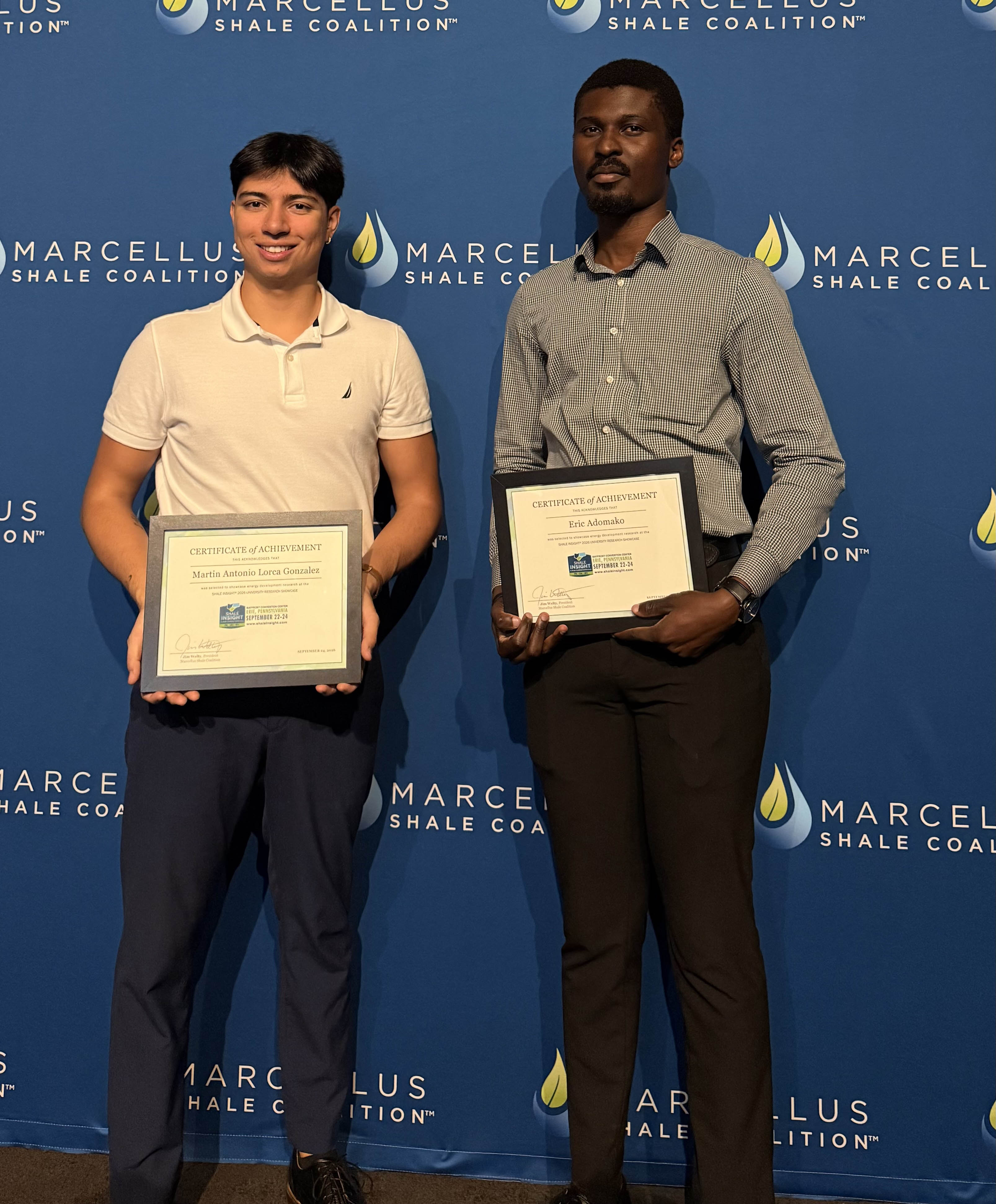
Martin Antonio Lorca, an undergraduate geology student, presented “Geologic Hydrogen as Commercial Resource in the Appalachian Basin.” His research integrates regional magnetic and gravity data to characterize the architecture of the basement rock. It also examines whether the Salina Group evaporite sequence could limit vertical gas migration and influence how fluids are separated underground.
Eric Adomako, a graduate student in chemical engineering, presented “Investigating Hydrogen Sorption by Shale and Its Impacts on Underground Hydrogen Storage Feasibility.” His research uses laboratory experiments and data analysis to study how hydrogen interacts with shale and coal, and how those interactions may affect storage capacity and containment.
The students were among up to 10 selected for the annual showcase based on the quality and regional relevance of their research and its significance to emerging energy challenges. They prepared technical posters and discussed their work with industry leaders, policymakers, researchers and other students. Both received Certificates of Achievement recognizing their research contributions and professional development.
The projects address complementary questions in the emerging hydrogen field: where naturally occurring hydrogen may be found and accumulate, and how subsurface formations may store hydrogen. For the Appalachian Basin, geologic hydrogen could offer a potential energy resource that draws on the region’s existing energy infrastructure and expertise. Researchers are still investigating how hydrogen is generated, moves underground and accumulates, as well as whether it can be recovered commercially.
Understanding how hydrogen interacts with rock is also important to evaluating underground storage. Sorption – the way hydrogen is taken up and retained by rock – can affect how much hydrogen a formation can store, retain and release.
“Martin and Eric demonstrated exceptional dedication, creativity and professionalism throughout their research projects,” said Vahid Atashbari, their advisor and leader of YSU’s Geo-Energy Initiative. “Their ability to communicate complex scientific concepts to a diverse audience at SHALE INSIGHT® 2026 reflects both the quality of their work and the strength of YSU’s GEO-Energy Resources research team.
Atashbari said the initiative’s work includes research and workforce development in conventional and emerging energy resources, subsurface energy systems, carbon management and regional energy development. The student projects also reflect collaboration across geology and chemical engineering, bringing together expertise in earth systems and interactions between fluid and rock.
Tom Jordan, a faculty member in YSU’s geology program, also contributed to the research.