
YSU faculty member honors mentor’s legacy through new book
When Amy Fluker’s new book debuted at the Society for Civil War Historians conference in Richmond, Virginia, it marked both a professional milestone and a deeply personal promise fulfilled.
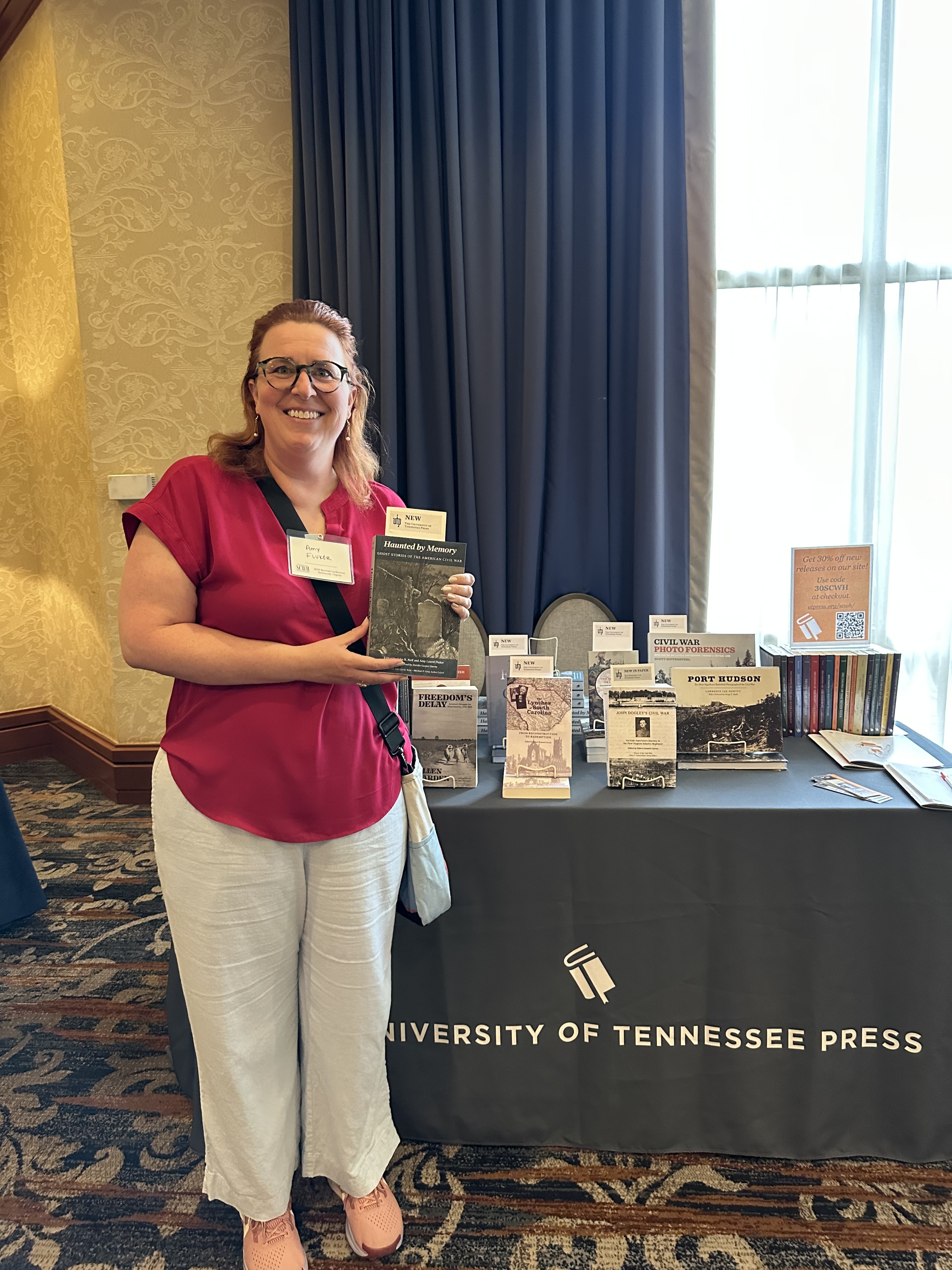
“Haunted by Memory: Ghost Stories of the American Civil War,” released in May, grew from the decade-long research of Fluker’s graduate school adviser and mentor, the late John R. Neff. After Neff passed unexpectedly in January of 2020, his wife, Kathy, contacted Fluker several months later and asked whether she would finish the project.
“Yes, a million times, yes,” said Fluker, distinguished associate professor of history at Youngstown State University. “It was just the honor and privilege of my life to be able to do that.”
For Fluker, completing the book was a way to honor a mentor whose guidance had helped make her career possible. She studied under Neff for nine years at the University of Mississippi, where he was an associate professor of history and director of the Center for Civil War Research.
“I would not be where I am if it hadn’t been for his guidance and his mentorship,” Fluker said. “There’s no way. Just from the advice to the chats and check-ins and the mentorship – and then even just the dozens of letters of recommendation he wrote for me for jobs – I would not be where I am without him.”
Taking on the book, she said, never felt like an obligation. It was an opportunity to give back.
“Haunted by Memory” brings together hundreds of ghost stories found in the Civil War-era and postwar newspapers, veterans’ publications and regimental histories. Coauthored by Neff and Fluker, the annotated anthology examines stories told by people who lived through the Civil War, rather than modern tales associated with battlefields.
Neff’s research began while he was searching newspapers for obituaries of Civil War veterans. He wanted to better understand what veterans died from later in life and whether those deaths could be related to wartime injuries. During that work, he found a ghost story – then another – and followed the subject for the next 10 years.
“He always envisioned it as a collection of ghost stories with some explanation and analysis baked into it,” Fluker said.
After inheriting the project, Fluker expanded the research and helped shape the book’s historical analysis. The stories are entertaining, she said, but they also reveal something more serious about the people who shared them.
Many of the stories identify people whose names, regiments and wartime experiences can be verified. Fluker cannot prove whether those individuals saw ghosts, but she can confirm the real lives at the center of their accounts.
“The stories aren’t totally made up,” she said. “There’s a kernel here of real people who had some kind of experience that they wanted to share.”
The accounts also offer an intimate view of how Americans experienced grief after the war. Many Civil War dead were never identified or returned home, leaving families with no clear answer about the fate of someone they loved.
“There’s so many Americans who just never knew what happened to their loved ones,” Fluker said. “They’re literally haunted by the absence of this person and the uncertainty of knowing the circumstances of their death.”
Some stories describe what Fluker calls “hopeful returns,” when a presumed-dead soldier unexpectedly comes home and is first mistaken for a ghost. Others recount veterans living with amputations and phantom limb syndrome – men who describe themselves as haunted by the absence of their own arms or legs.
The book covers 1861 through 1932, roughly the lifespan of the Civil War generation. That period, Fluker said, demonstrates that the war’s trauma did not disappear when the fighting ended.
“They are haunted for the remainder of their lives by the things that they suffered and witnessed in that war,” she said.
For Fluker, the project also opened an unexpected scholarly path. Although she had always enjoyed “spooky stuff,” she had not realized ghosts could be studied seriously within academic history. Completing the book required her to explore scholarship in philosophy, psychology, literature and other disciplines where ghosts have long been examined as a part of cultural life.
She brought that interdisciplinary work to YSU by creating a haunted history course, which she has now taught three times. Students study how people have used ghost stories across history before examining American ghost beliefs and Civil War sources, including documents Fluker uncovered for the book.
“It’s definitely been, I think, the project I’ve done that has blended my teaching and scholarship,” she said.
The connection would have pleased Neff, Fluker said, because he was a teacher first and foremost.
At the Richmond conference, the book’s debut showed Fluker how far Neff’s influence continues to reach. Colleagues responded enthusiastically to the book’s new approach to Civil War memory, while scholars who knew Neff were glad to see his work completed. One graduate student approached Fluker to say how happy she was that “Dr. Neff’s book” had been finished. The student had never known Neff personally but had been taught by one of his former students.
For Fluker, the moment affirmed both her mentor’s legacy and the value of carrying his work forward in her own scholarship and teaching at YSU. Through “Haunted by Memory” and her haunted history course, she is helping students see that even seemingly unusual subjects can reveal enduring truths about grief, memory and the human experience.