
Weiqing Ge receives national honor for advancing social responsibility in physical therapy
Faculty SPOTLIGHT
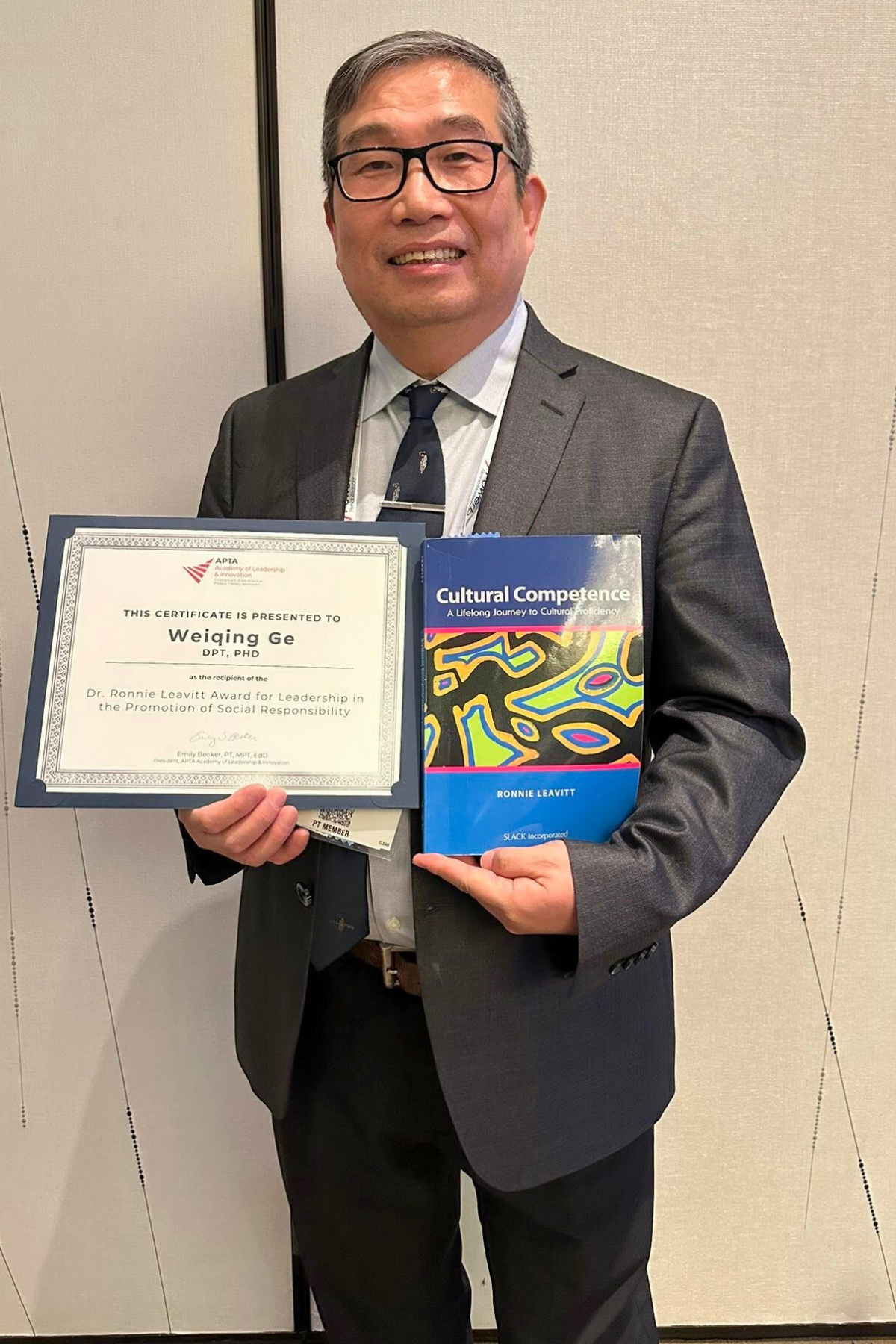
Weiqing Ge, professor of Graduate Studies in Health & Rehabilitation Sciences at Youngstown State University, has been named the recipient of the Dr. Ronnie Leavitt Award for Leadership in the Promotion of Social Responsibility from the American Physical Therapy Association Academy of Leadership and Innovation.
Ge received the national honor during the APTA 2026 Combined Sections Meeting, held Feb. 12–14 in Anaheim, California. The award recognizes an APTA member whose contributions demonstrate leadership in promoting social responsibility locally and globally through service, scholarship and advocacy.
For Ge, the recognition is both personal and professional.
“Personally, this confirms that what we have been doing at YSU over the past several years is on the right track,” Ge said. “It also reflects our students and our program at YSU. This award belongs to them as well.”
The award also carries special significance. Years ago, Ge had the opportunity to teach a new course titled Language, Culture and Health. He redesigned the course to be centered more on cultural competence and health disparities, to better align with the accreditation requirements. The department chair, Nancy Landgraff, shared with Ge the textbook “Cultural Competence: A Lifelong Journey to Cultural Proficiency” by Ronnie Leavitt. Ge attributes that textbook to shaping his career, making receipt of this award even more meaningful.
“That course changed everything I am doing now,” Ge said. “Much of my work in cultural competence, health disparities and community engagement started there.”
Today, the frame of Ronnie Leavitt’s book continues to guide his teaching, research and service. Ge emphasizes that physical therapy extends beyond one-on-one patient care to population health, community design and the social determinants of health.
“We’re not only treating individuals,” he said. “We’re also looking at how communities are built, whether people feel safe going outside and whether they have places to go – parks, trails, grocery stores. Those factors influence physical activity to improve physical and mental health, along with societal benefits.”
That philosophy has translated into significant community partnerships and grant-funded initiatives. Ge serves as co-principal investigator and strategic lead for safe and accessible community design through YSU’s GuinFit initiative, funded by the Centers for Disease Control and Prevention’s Racial and Ethnic Approaches to Community Health program. The five-year cooperative agreement supports efforts to address health disparities in the Mahoning Valley.
This project integrates physical activity promotion, nutrition access and family involvement. One focus is ensuring residents feel safe walking or biking to everyday destinations. Ge is also a member of the Active Transportation Action Team of the Healthy Community Partnership of Mahoning Valley. As part of the safe and accessible community design for physical activity, GuinFit collaborated with the HCP to conduct demonstrations on Federal Street and Mahoning Avenue in 2024. He presented this work to fellow physical therapists around the world at the World Physiotherapy Congress in 2025 and received an ePoster award that represents physical therapists from the North America Caribbean region.
As part of that work, Doctor of Physical Therapy students conduct walkability audits in local communities. After receiving technical training through Safe Routes to School Partners made available by the CDC, students assess sidewalks, crossings, traffic behaviors and accessibility barriers.
Their findings have informed community planning efforts, including Howland Township’s transportation safety planning and the $10 million East Market Street Corridor improvement plan. The walkability audit conducted by the students was incorporated into township documents addressing pedestrian safety and infrastructure improvements.
“For students, this is first-hand experience,” Ge said. “They see how their work contributes to real change in the community. Many come to physical therapy wanting to treat patients one by one. Through this work, they see the broader impact of the profession in population health which aligns with the APTA’s Strategic Plan and Public Policy Priority.”
In addition to community-based infrastructure efforts, Ge’s work also addresses transportation safety and mobility at the university level. He leads two U.S. Department of Transportation Safe Streets and Roads for All grants focused on transportation safety and active mobility.
One project centers on YSU’s campus and surrounding area, examining how faculty, staff and students travel and identifying safety concerns and “hot spots” – including near-miss incidents not captured in official crash reports. The goal is to improve pedestrian and bicycle safety and promote active transportation, such as walking, biking and public transit use.
“Traffic crashes are a leading cause of death among college students,” Ge said. “If we can make students feel safer walking or biking and give them safe routes to travel, we can improve both safety and physical activity while addressing transportation as a barrier for higher education.”
The initiative includes collecting data to identify safety hot spots and piloting community-informed solutions.
Ge’s commitment to social responsibility extends beyond the local level. He has secured two U.S. Department of State grants supporting international symposium focused on disability culture. The programs brought together U.S. and Chinese scholars, clinicians, students, government officials and community members to discuss differing cultural perspectives on disability and inclusion.
In certain cultures, Ge explained, the culture of disability does not exist so individuals may hesitate to identify as having a disability due to stigma, as stated in Ronnie Leavitt’s book. By contrast, U.S. systems often connect disability status with services and protections. The symposium created space for mutual learning. During one visit abroad, Ge and colleagues observed a community volunteering center providing free weekly health services, regardless of their ability to pay, and daily Tai Chi classes for residents – an approach that offered lessons in long-term community commitment.
“Social responsibility is global,” Ge said. “We learn from each other.”
Ge also serves on the Combined Sections Meeting Review Committee for the APTA Academy of Leadership and Innovation, reviewing national submissions and staying connected to emerging ideas in the profession. He also served as the Membership Chair for the APTA Academy of Clinical Electrophysiology and Wound Management for two terms and established a student special interest group.
He emphasized that students are central to his receiving the award.
“In my acceptance speech, I recognized our students,” Ge said. “They contribute in ways they may not even realize. Through these projects, they learn professionalism, leadership and social responsibility.”
The students have always been a part of his conference presentations and peer reviewed journal publications. This led to receiving the top award at the World Physiotherapy Congress in 2021 for Outstanding Platform Presentation.
By integrating community audits, cultural competence education, grant-funded research and global dialogue into the curriculum, Ge has broadened how YSU’s DPT students understand the profession.
“This recognition strengthens what we are doing at YSU,” he said. “It confirms that our work in community health and safety addresses health disparities”
Through local infrastructure improvements, campus safety initiatives and international collaboration, Ge’s work continues to demonstrate how physical therapy can advance population health – not only in clinics, but across communities.