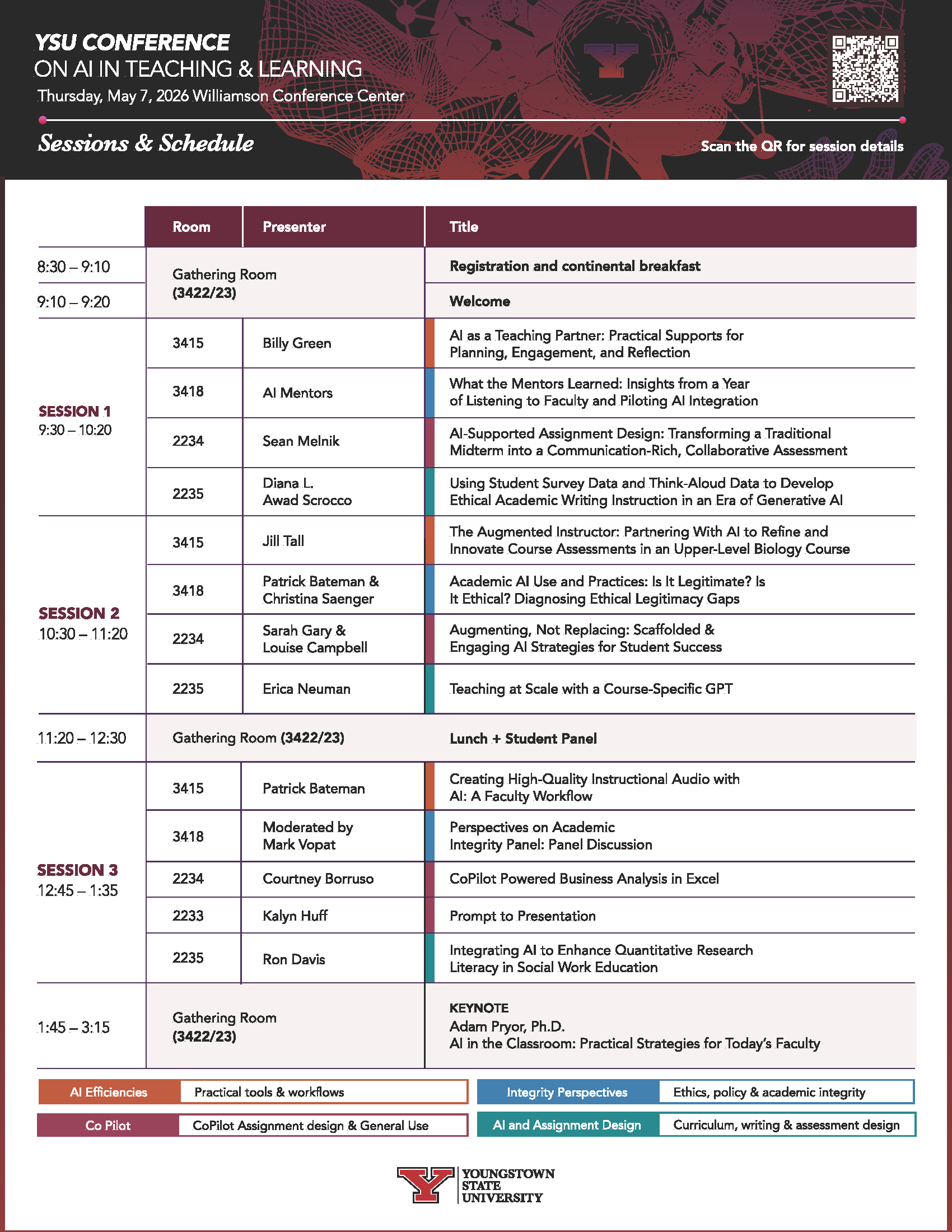
YSU Conference on AI in Teaching & Learning

Call for Use Cases


Date: Thursday, May 7, 2026
Location: Williamson Conference Center
Submission Deadline: January 31, 2026 via the Submission Form


Theme - AI in Action: Practical tools for Faculty and Students

As we look toward the next academic year, the conversation around Artificial Intelligence at YSU has moved beyond "What is it?" to "How do we actually teach with—or despite—it?"

Faculty feedback from the last year has highlighted a diverse range of experiences: some of us are using AI to innovate curriculum or organize research, while others are concerned about the AI’s impact on student writing skills, critical thinking, and academic integrity.

We invite proposals for our May 2026 Conference that move beyond generalities. We are seeking faculty willing to share concrete activities, assignments, and classroom policies that they have piloted. Whether you are an AI enthusiast or a skeptic who has found a way to "AI-proof" your assessments, your colleagues need to hear your strategies.

Specifically, we are interested in presentations from faculty who are exploring and experimenting with AI in their teaching—we are all learning together, and you don’t have to be an expert to share the work you’re doing!


Suggested Proposal Tracks

Track 1 - Supporting Foundational Skills & Pedagogy

  • AI Literacy for All: Educating students and faculty on the mechanics, appropriate use, and limitations of AI in the educational environment.
  • Human-Centric Assessment: Developing methods that ensure students maintain core writing and thinking skills (e.g., in-class writing, oral defenses, and process-based grading).
  • Engagement-First Design: Course and assignment structures specifically focused on encouraging student presence and participation in online environments.

Track 2 - The Faculty Toolkit: Efficiency & Content Creation

  • Course Design & Material Generation: Best practices for using AI to create course overviews, lecture outlines, and multimedia content (e.g., using ElevenLabs for audio or image generators for visuals).
  • The Augmented Instructor: Utilizing AI within LMS platforms (like Blackboard) for grading assistance, providing faster feedback loops, and automating administrative tasks.
  • Teaching with Agents: Implementing custom-built GPTs or chat agents as virtual TAs or tutors to support student learning outside of office hours.

Track 3 - AI as a Tool

  • Scaffolding with AI: How to teach "idea springboarding" and organizational strategies in ways that augment, not replace, human cognition.
  • The Hybrid Deliverable: Showcasing assignments where AI is used for preliminary research or drafting, while the final product requires rigorous human critical analysis and synthesis.

Track 4 - Policy, Ethics, and Integrity

  • Frameworks for the Future: Sharing syllabus language and departmental policies that have successfully clarified boundaries for students.
  • Critical Consumption: Strategies for teaching students to "fact-check" AI outputs, recognize algorithmic bias, and identify hallucinations.
  • The Ethics of Data: Discussing the privacy implications of AI in the classroom and the intellectual property rights of AI-generated work.

Track 5 - Discipline-Specific & Professional Applications

  • STEM & Technical Innovation: Using AI for complex visualizations, coding labs, and checking math/physics conceptualization.
  • Humanities & Arts: Addressing AI’s tendency to "homogenize voice" or "hallucinate" facts while leveraging AI as a collaborative partner or in journalism, history, art, creative writing, and content creation.
  • Business & Modern Practice: Bridging the gap between business classes and industry use. Exploring how AI is transforming accounting, finance, business analytics, marketing, supply chain management, and corporate decision-making.
  • Professional Preparation: Aligning classroom instruction and hands-on experiential learning with how AI is being used in the workplace.

Presentation Formats

All sessions are expected to run 50 minutes, with 10-minute breaks between.

  • Workshops: Interactive sessions where participants build an assignment or learn a tool together.
  • Panel Discussions: 3-4 faculty members discussing a specific theme (e.g., "AI in Writing-Intensive Courses").
  • Presentation: Introduction of a new tool or method, with time reserved for questions or discussion.
  • Structured discussion: Short presentation on a topic, followed by a structured small or large group discussion.

We are open to creative formats, such as shared presentations, demonstrations, panels, structured discussions, etc., if one of the above formats does not fit your topic.


How to Submit

Please submit a brief abstract (250 words max) describing your proposed session and its key takeaways for colleagues via the submission form by January 31, 2026.